Village Math
A tool for engaging with capitalism

We’ve been reimagining school subjects, slowly building a Village Curriculum that encompasses the skills, knowledge, and ways of being that we need to build an equitable and just future.
This fall, we’re hosting Village Math at the local library for anyone who wants to join. A more accurate name would be Engaging with Capitalism: Questions That Require Arithmetic. Finance was an obvious place to start because it’s a topic within numeracy that we all need but learn so little of in K-12 schools. We estimated how much a week’s worth of groceries might cost from the grocery store vs. our own homesteads. This week, we looked at the pathways that our society has created to access shelter and what it would take (money or otherwise) to acquire the shelter we wanted.
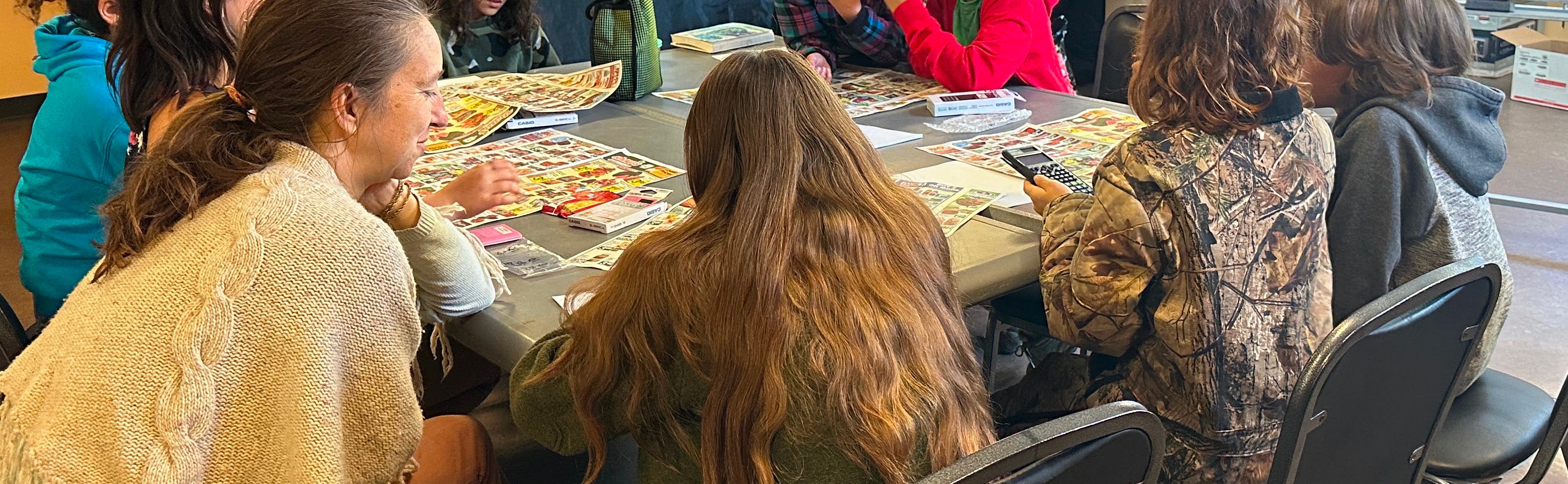
The flow that has developed goes like:
Present a juicy real-life question e.g. How much does it cost to feed your family for a week? This is not “real life” the way a textbook puts words and numbers in a sentence together to make a problem feel more relevant, e.g. “Susan has 5 apples.” This is real in that you are guaranteed to need to figure this out one day. Doesn’t have to be today, but it is authentic in a way that most math problems are not.
Work in teams for a good half hour, usually writing down calculations on paper so that others can follow our thinking.
Share our process/solutions with each other. And it’s beautiful that these questions do not have a correct answer. We also look at averages are in the US for the financial topic at hand.
We work in teams not just to solve problems but more and more to imagine a life together. Two kids budgeted $61.09 for seeds to start a garden after a long discussion about which vegetables to grow. One group estimated the cost of rooming together in a yurt (with a fancy, automated toilet) on shared land on a farm.
What options exist within the systems we’ve created now? What do we want our future to look like? Math as a tool for meeting our basic needs, I can definitely get behind. Algebra and calculus as currently taught, the jury is still out.


Interesting reads:
Math Myth by Andrew Hacker
Math with Bad Drawings by Ben Orlin